
Four years of AI in recruitment, and everyone is telling us it changes everything. So what has it actually changed?
My opinion, but if you strip out the keynotes and the rich dudes in Patagonia vests, and look at what's genuinely different about the job day to day, It’s actually quite a short list.
BUT, there are some elements of AI that I believe have or at least can, fundamentally change the way we hire. Lets pop on our TA nerd trousers, set our AI sceptic cap to a jaunty angle, and get stuck in.
1. Don't sleepwalk into being a software consumer
If your team's AI strategy is an AI screening tool plus an AI sourcing tool then all you have done is buy two SaaS products. They happen to have AI in them.
Your team's skills, workflows and cost base look exactly like they did in 2021.
You all know I love a good tool. But buying AI features and calling your team AI-enabled is how you end up four years in with nothing to show for it except the invoices.
An AI-enabled team changes how it works and the individual level.
2. Stop Paying for Software, Start Paying for Data.
At Ava Labs our theme is stop paying for software, start paying for data, then build internal tools that use that data.
Two things come out of this.
It costs a fraction of the price. Data services and APIs are teeny weeny compared to a big honker of a LinkedIn Recruiter contract. You pay for the raw material and build exactly what you need on top.
It forces recruiters to learn AI properly. Using AI to write outreach is the shallow end of the kiddie pool. Our recruiters are building small tools, wiring up APIs, wrangling data and building things that are bespoke to their needs. In my team I want using AI to feel like using spreadsheets. Its free to all and there’s an expectation you know how to work it to your advantage.
Some people will look at that and see an operational inefficiency. Recruiters should be recruiting, right?
Fair point. My view is this is perfect practice for a skill set every knowledge worker is going to need. Better to learn it now, on low-stakes internal tools, than scramble for it in two years.
3. The unit economics of sourcing have changed
This is the big one in my opinion. If you only take one thing from this issue, take this.
We can now find relevant people programmatically. That's the single biggest change AI has made to the core outcomes of recruitment.
Here's how I'd rank where most teams are:
| Approach | What it gets you |
|---|---|
| Sourcing manually for live roles | Fine. It works. |
| Using AI to source live roles faster, then picking up a couple of extra reqs | Marginally more efficient. You've missed the size of the change. |
| Sourcing programmatically for live roles AND everything that might happen | A completely different operating model |
Here's what we source for now at Ava Labs:
- Live roles. Obviously.
- Backup discs for critical roles. Anyone in a critical position has a sourced pipeline sitting behind them.
- Succession gaps. Anyone without a successor or succession plan, we source for.
- Ahead of demand. In quarterly business planning we ask leaders what their org will look like, then source for every eventuality. If the BD team gets extra headcount once they hit X customers this year, we source for that trigger now.
"But Luke, you blithering simpleton! That sourcing can't possibly be as good."
You're absolutely right… head voices. It isn't.
Treat it as a market intelligence sweep. Every player in a given field, location and level. Say it's 50% as good as a recruiter's manual sourcing, and it costs 1% as much (made-up numbers, don't judge me). That's still a fantastic deal. The cost-to-benefit ratio is huge.
The worst case, We burned a few tokens on a batch of candidates that's a bit less relevant. And that batch might still be useful next year.
How it works in practice: the sweeps go into projects in our ATS. When a role goes live, recruiters calibrate, polish and refine what's already there. Far less effort than starting from zero.
So when a hiring manager rocks up with "Paul's not been happy for a while, he's leaving, we need to start the search IMMEDIATELY"... we walk into that kickoff and say:
"We've been sourcing for this for the best part of six months. Let's calibrate now. Here are some candidates."
The hiring manager then says;
I didn’t know you guys had a pre-cog division. Why are we using stochastic quantum computers to hire for Regional Business Development Managers? Surely you should be fighting crime?
What we get out of it:
- Lower time to hire
- Happier hiring managers
- Far more market intelligence
- Recruiters who actually know how to use AI
4. It killed the PowerPoint
Possibly the most glorious victory of the 21st century.
Anything we present to candidates or hiring managers can now be a rich, interactive, perfectly branded single-page website. Host it on your internal infrastructure, or chuck it on a free Netlify account.
Presenting data and insights this way makes us look far more professional. And it takes less time than building a deck. Win straight off the bat.
So…
AI hasn't changed everything for recruiters. Its not going to replace us. BUT, there are a lot of us just letting the tide of commercial products sweep us away.
NOW is your time to use AI to develop a new paradigm for yourself as a recruiter that will set you up for the remainder of your career, and have a smidge of fun doing it.
Luke Update
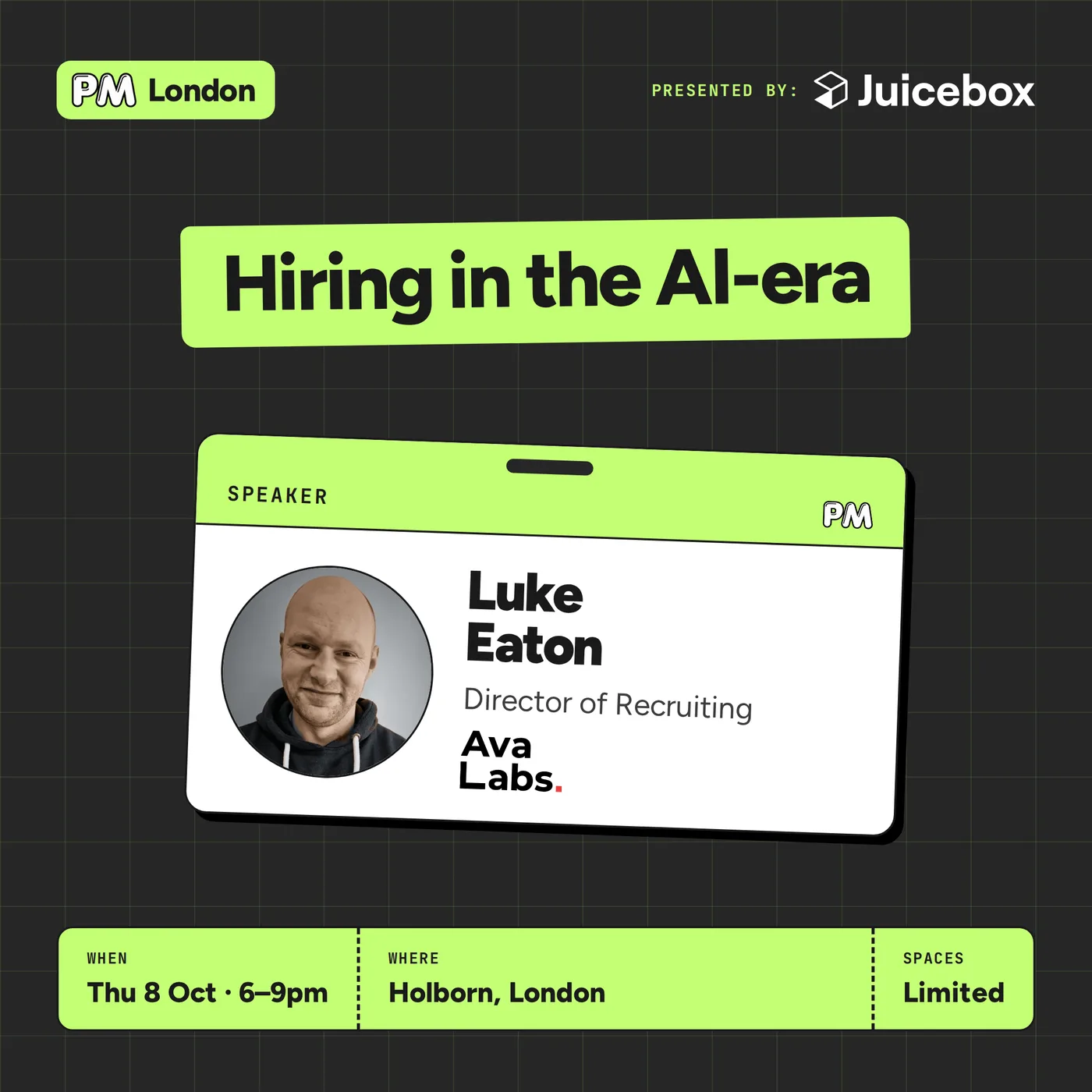
Next week, I will be in London with the PromptMate crew for their live event, talking about what the new AI recruitment playbook actually looks like in real terms.
I'll also be alongside the awesome Leti Taylor from Monzo as well as Rob Campbell and Nick Goodwin from Lovable. Details are below. Feel free to register and come hang out with me next week!
Well... that's issue Eighty! If you have any questions about it, or any feedback on this issue of The Data Driven Recruiter, grab me on LinkedIn for a chat.
I'll see you next week!