
When it comes to successfully scaling a business, hiring efficiently is more important than hiring quickly.
Imagine two race cars. They both have the same objective. Win the race.
Car One chooses a very sensible course of action. To win the race, they have to go as fast as possible.
Car Two chooses a different course of action. To win the race, they have to take every curve as efficiently as possible.
Which car wins? Car two of course. Car one is a flaming pile of scrap embedded in the wall of the first curve.
In my experience the same is true of scaling a business. If hiring fast is more foundational to hiring smooth, you will make really expensive, inefficient choices that will become entrenched in your process as you scale.
That one off agency hire becomes the standard process. That additional, unstructured CEO chat becomes a requirement. That one role that cost £11k to hire is now 20 roles at £220k.
So, how do we hire with efficiency as a core principle?
So, how do we, the lowly recruiters change the mindset of the business to hire efficiently?
1️⃣ Push back on CEO/Founders who want to act fast once they get that investment/big customer.
2️⃣ Measure volume, conversion and capacity for every role. Use these conversions to measure the level of effort per hire (use my sheet if you don't have one).
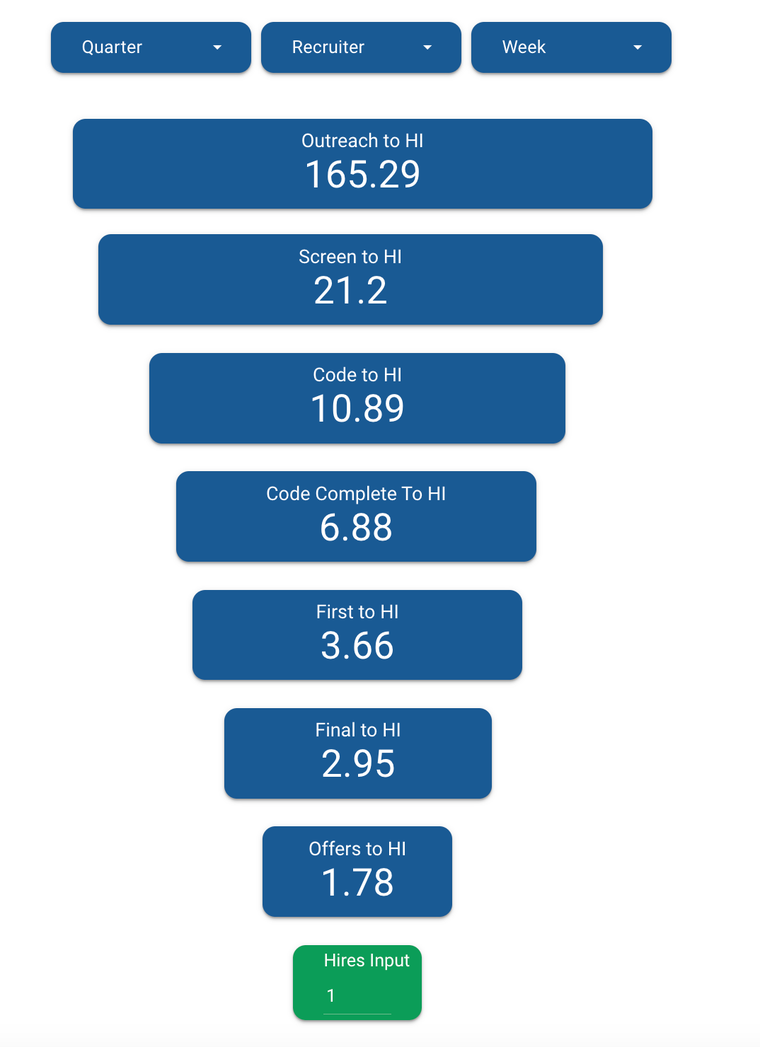
If you don't know how to do that, here is a tool I put together to do that for you. But basically, Level of Effort is how many x,y,z to make one hire. How many screens, how many interviews, how many offers etc.
To calculate this just for offers you can go (SUM(Offers)/SUM(Hires)) * Target hires (good for a sheet or BI tool)
Or you can go (1+ offer decline rate) * Target hires. For example for 10 hires with an offer accept of 75%, is 1.25*10 = 12.5 offers needed to make 10 hires.
Using Level of effort you can start to objectively measure how much effort you are putting into each role and seek to improve on that with better processes and practices.
The goal is to bring the LoE to make one hire down by an order of magnitude, THEN scale those processes and best practices up. this ensures your cost per hire is low as you scale, your hiring velocity it high, the least amount of engineer or other domain specialist time is being used for recruitment.
If one hire currently requires 6 tech interviews on average, and each interview is 2 engineers, thats 12 hours of engineering time devoted to recruitment. what happens if you are hiring 100 engineers? 1200 hours of engineering time, thats a feature, or an entire products worth of engineering time spent interviewing.
3️⃣ Set up quarterly retrospectives with your leadership. Agree specific areas where you will increase conversion/efficiency that quarter.
4️⃣ Normalise your hiring plan. How many external hires could be promotions? Back fill the more junior roles in less time and at a lower cost, increase retention by promoting more.
5️⃣ Measure throughput. How many hires can your business make in a quarter based on your current process?
6️⃣ If you are going to use agencies, use them as a contingency for roles that, if taken internally, would reduce the throughput of your team (stuff like SalesForce Architects and the like).
Heres an example of what LoE could look like for 1 hire:
Book Update
Thanks to everyone who replied with interest about my upcoming book The Data-Driven Recruiter Handbook.
My goal for the book is to be to recruiters what the agile handbook is to project managers.
Firstly, basic measures & principles and how they relate to each other. Then, we move onto some more advanced concepts. And finally, we will go through scenarios that will allow you to visualise how you would put these concepts into practice in your own business.
So read it, study it, but also have it on hand to dip into it when you need it.
Rough structure will be :
Part One - Foundations
Part Two - Advanced Concepts
Part Three - Scenarios.
So in the same way the Agile handbook is broken into foundation and practitioner, this will be broken into the theory then real life application.
I'm really keen for this to be a practical book you can use time and time again, not some throw away marketing thing.
If you have any thoughts or feedback on what you want in there, hit me up on LinkedIn for a chat.
Well... that's issue eight in the bag. Remember recruiting LEAN and doing more with less is the businesses mantra in 24/25, so make sure you are measuring the right things to reduce LoE.
If you have any questions or feedback on this issue of The Data Driven Recruiter, grab me on LinkedIn for a chat.
I'll see you next week!