Hello my vibrant, shamelessly attractive recruitment warriors! Lets talk about something really boring, but doing it right is the difference between being a credible recruiter and hiding under a piano, drinking Gin and crying.
Let's talk governance.
So, recruitment pretty much lives or dies on decisions.
- Who makes them. When they’re made. How they’re made. And what happens when people disagree.
That’s essentially governance.
And despite how important it is, most recruiters, including a lot of recruitment leaders, don’t really think about it, nevermind design it intentionally.
Which is massive problem.
Because when governance is missing, unclear, or implicit rather than explicit :
- Hiring slows down Accountability gets fuzzy Recruiters become process babysitters And everyone feels like “recruitment is the blocker”
When governance is clear?
Recruitment suddenly gets easier.
Here are governance tools to help you out.
What is Governance
In business and project management, governance is essentially:
The framework that defines how decisions are made, who is involved, who owns what, and how accountability works.
It’s not bureaucracy, and it’s definitely not about control.
Good governance is there to:
- Reduce confusion Prevent rework Speed up decision-making Protect people’s time And make outcomes more predictable
In recruitment terms, governance answers questions like:
- Who actually owns the hiring decision? Who needs to be consulted vs informed? Where does recruiter autonomy end? When does escalation happen? What happens to the interviewer if they don't give feedback?
If those answers aren’t explicit, you have poor governance.
Why Us Recruiters Should Care
It helps you:
- Fewer circular conversations Less stakeholder chasing Less “just one more interview” bollocks Clearer pushback when scope creep appears Better expectation-setting with hiring managers
Governance Frameworks
Below are tools and models I’ve used repeatedly.
I’ve kept this to four but i recommend you just use whatever is relevant to you and what you are trying to achieve.
1. RACI Charts
This one comes from project management, and it’s criminally underused in recruitment. In my view it should be a standard portion of any kickoff call.
A RACI clarifies:
- Responsible – who does the work Accountable – who owns the outcome Consulted – who provides input Informed – who needs visibility
Where it works brilliantly in recruitment:
- Hiring decisions Interview feedback ownership Process changes Offer approval flows
Pros
- Removes ambiguity Creates defined accountability Exposes decision bottlenecks immediately
Cons
- Feels “corporatey” if you over do it. Needs a bit of upkeep when roles change It only works if people respect it
If you’ve ever asked “why am I chasing this?” or felt hopeless when a really poor stakeholder just gets away with it, you needed a RACI.
2. Decision Rights Frameworks (RAPID-style thinking)
Another project-management classic, adapted for decision-heavy environments.
These frameworks focus less on tasks and more on decisions:
- Who recommends? Who provides input? Who decides? Who executes? Who needs to know?
This is incredibly powerful for:
- Interview debriefs Bar-raiser models Final hiring calls Conflicting stakeholder opinions
Pros
- Speeds up decisions Reduces consensus theatre Makes escalation clean, not political
Cons
- Requires senior buy-in Can feel uncomfortable in high-ego rooms
Recruitment is a decision factory. If decision rights aren’t clear, everything slows.
3. Stage-Gate Governance
This one is more operational.
You define:
- What must be true to move a candidate forward Who validates that at each stage What evidence is required (not opinions)
This works especially well in:
- Early funnel stages High-volume hiring Technical or skills-based screens
Pros
- Predictable Scales well Reduces false positives early
Cons
- Risk of false negatives if poorly designed Needs really strong calibration
4. SOPs (Standard Operating Principles)
This isn’t a framework so much as a layer that sits over everything else.
They should be explicit statements like:
- “No one interviewer can veto a hire alone” “Culture add is discussed collaboratively, never in isolation” “Recruiters own process, hiring managers own decisions” “More interviews require new signal, not reassurance”
Pros
- Easy to communicate Reinforces good behaviour Reduces edge-case debatathons
Cons
- Needs reinforcement Useless if treated as just slogans
I love SOPs because they cost nothing, and quick to create and help with your broader management of a recruitment functions.
So...
Crappy governance :
- Unclear ownership Implicit decision-making Undefined roles And governance that exists only in people’s heads
Awesome governance:
- Makes recruitment faster Makes decisions fairer Makes recruiters more effective And quietly removes friction everywhere
Luke Update
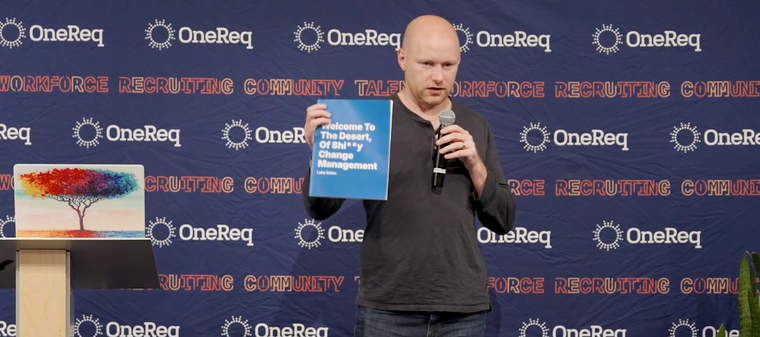
Last year I wrote a book on change management for recruiters called "Welcome to the Desert of Shitty Change Management"
I wrote it mainly to get out of designing slides for a talk I did at last years RecCopsCon in Chicago. So two weeks work to escape 45 minutes work (I really suck at design stuff as you have probably already gathered).
Anyhoo, next week I'm going to try to get it up as an E-Book on my website. It has a bunch of time tested frameworks for change management and communicating change which is really helpful for stuff like rolling out a new tool. Heres me at RecOpsCon waving it about like a preacher.
Well... that's issue fifty seven! If you have any questions about it, or any feedback on this issue of The Data Driven Recruiter, grab me on LinkedIn for a chat.
I'll see you next week!