
The rollout is done. The decks were a masterpiece. The vendor’s gone home. Everyone claps."woo, well done Luke!.....you are recruitment batman!!!!!"
The new system is live! Everyone has their new logins and access to the awesome new tool that will solve our problems!
And three months later you are staring at a dumpster fire.....
Your recruiters have gone back to spreadsheets. Hiring managers quietly ignore reminders. The “automation” doesn’t automate. The data is still garbage.
And there you are staring out across the dunes, wondering where all that enthusiasm went.
Welcome......to The Desert of Shitty Change Management.
The place where good tech, good intentions, and good money go to die.
Because most teams think that implementation is change.
It’s not.
It’s the start of change.
And unless you know how to lead people through that barren middle bit, where old habits fight back and enthusiasm fades, you’ll be buying another tool in 18 months and calling it “a strategic reset.”
Heres one time tested framework for change. I'll be covering multiple frameworks of the next few weeks so stay tuned.
Kotter's 8 Steps for Organisational Change
John Kotter, a Harvard professor, published Leading Change in 1996 after studying hundreds of organisations trying to transform.
He found that most didn’t fail because of strategy or technology; they failed because they ignored human behaviour and culture.
So he built a framework, Kotter’s 8-Step Process for Leading Change, that describes what successful change looks like from start to finish.
It’s simple, structured, and still one of the most referenced models today.
1. Create a Sense of Urgency
Establish a shared recognition that current conditions are untenable. This involves showing evidence of inefficiency, missed opportunities, or external pressures. Without urgency, people remain comfortable in existing routines.
2. Build a Guiding Coalition
Identify influential stakeholders who are committed to the change. These individuals must represent authority, credibility, and expertise. The coalition becomes the driving force that overcomes resistance.
3. Form a Strategic Vision and Initiatives
Define a clear, compelling vision that articulates where the organisation is going and why. This vision must translate into concrete initiatives that guide decision-making and prioritisation.
4. Communicate the Vision
Repeatedly communicate the vision through multiple channels. Leaders must embody the change in their actions as much as in their words. Inconsistent or unclear communication creates confusion and doubt.
5. Remove Obstacles
Identify and eliminate barriers such as outdated processes, resource shortages, or resistant managers. Removing obstacles empowers individuals to act in support of the vision.
6. Generate Short-Term Wins
Demonstrate early successes that validate the change effort. These wins provide evidence that progress is real and build credibility among sceptics.
7. Consolidate Gains and Produce More Change
Use momentum from early wins to drive additional change. Avoid the temptation to declare victory too early; sustaining progress requires continuous reinforcement.
8. Anchor New Approaches in the Culture
Institutionalise new behaviours by embedding them into policies, procedures, and cultural norms. Long-term success depends on aligning incentives and recognition systems with the desired change.
Heres what it looks like in practice....
Let's say a scaling technology company implements a new ATS to improve recruitment efficiency and reporting accuracy.
The talent acquisition leader applies Kotter’s eight steps:
- Create Urgency Present data showing delayed hiring and candidate dropouts caused by manual scheduling and poor tracking. Establish that these inefficiencies are limiting growth. Build a Guiding Coalition Form a cross-functional team including TA Ops, Engineering, HR, and key hiring managers to champion adoption. Form a Strategic Vision and Initiatives Define a clear goal: “Reduce time-to-hire by 30% and improve feedback compliance to 90%.” Align initiatives such as workflow redesign and training around that vision. Communicate the Vision Deliver consistent messages across all-hands meetings, email campaigns, and Slack updates. Reinforce benefits to each group: recruiters save time, managers get faster hires, and leadership gains better data. Remove Obstacles Address technical issues early, simplify workflows, and ensure integration with HRIS. Remove bureaucratic blockers to tool access. Generate Short-Term Wins Launch a pilot with one department and share measurable results (for example, scheduling time reduced by 60%). Publicise these wins company-wide. Consolidate Gains and Produce More Change Expand adoption across departments using learnings from the pilot. Continue showcasing improvements in speed and accuracy. Anchor in the Culture Embed system usage into TA onboarding, performance reviews, and standard operating procedures. Ensure long-term accountability for data quality.
So, as you can see, there’s still a lot of work to do after the technical implementation of a TA tool.
When implementation ends, that’s when adoption begins.
All of your hard work, and all of the risks that threaten the return on investment you promised the business, are still on the table.
I’ve found Kotter really helpful when I’m staring at a blank page, asking myself: what the hell do I do next?
How do I actually implement adoption in this business?
It gives me a structure. It gives me somewhere to start.
There are plenty of other frameworks that overlap with Kotter, and I’ll dig into those next week.
But give this a go! Check out Kotter online, and let me know how you get on!
Luke Update
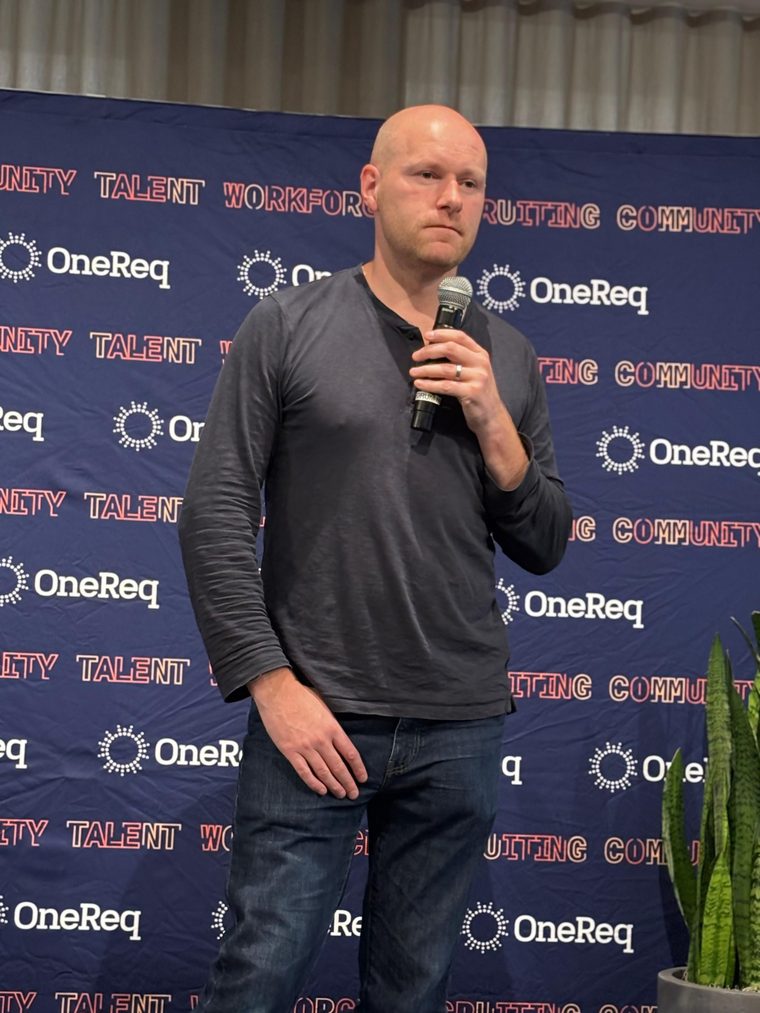
Just back from Chicago this week after another fantastic Recruitment Operations Conference (RecOpsCon).
I attended for the second year in a row, where I spoke in more detail about change management.
If you’re a recruitment operations professional and you’re looking for a place to really get under the hood of TA technology, RecOpsCon is hands down the best conference out there. It’s still small, everyone’s approachable, and the content is genuinely useful, real conversations about real problems.
Having been there for the past two years, one thing really stood out this time: the amount of work being done in AI.
Last year, the AI discussions were still high-level, questions like “Will AI replace recruiters?” and all the usual noise you see on LinkedIn.
This year, it was completely different. The conversation had shifted to use cases.
People were sharing exactly what tools they’re using, what’s working, what’s not, and what results they’re seeing.
We’ve come a long way in just a year.
There’s a huge amount of potential and some genuinely exciting applications emerging, especially from people who are actually on the ground making it happen.
Here’s a picture of me looking tired.
Maybe I’ll see you there next year.
Well... that's issue Fifty three! If you have any questions about it, or any feedback on this issue of The Data Driven Recruiter, grab me on LinkedIn for a chat.
I'll see you next week!