
Hi there recruiters!
If you have been in recruitment for 15 or so minutes, you will have learned that there are lots of things that impact your ability to do your job that are out of your control.
Some of the biggest headaches in talent acquisition don't actually have much to do with talent acquisition itself.
Many of the issues that create inefficiencies, frustrations, and missed goals actually originate upstream in the workforce planning process. BUT, these issues land squarely on the shoulders of TA teams, leaving them to scramble for solutions while your stakeholders point fingers.
I've completed three workforce planning improvement programs in the past 4 years and here’s the truth: poor workforce planning creates a domino effect that ripples across recruitment, product development, and ultimately, business performance.
Let’s get stuck into into the four downstream effects of poor workforce planning, and more importantly, how we can solve for them.
1. Priorities: A Mountain of P1s
The Problem:
When stakeholders assign priorities to their open roles, they naturally rank their own needs as top priority. The head of engineering says their roles are P1. The head of marketing says the same for theirs. And what does TA end up with? A giant pile of “P1” roles with no way to prioritise them across the business.
This lack of clarity forces recruiters into a reactive mode, juggling conflicting demands without a clear business-wide framework.
The Solution
Tie Priorities to Business Goals
Encourage stakeholders to link each role to a specific strategic goal. For example, is this role directly tied to a product release, revenue growth, or a compliance requirement? If a P1 role doesn’t directly support a high-priority goal, it should be deprioritised.
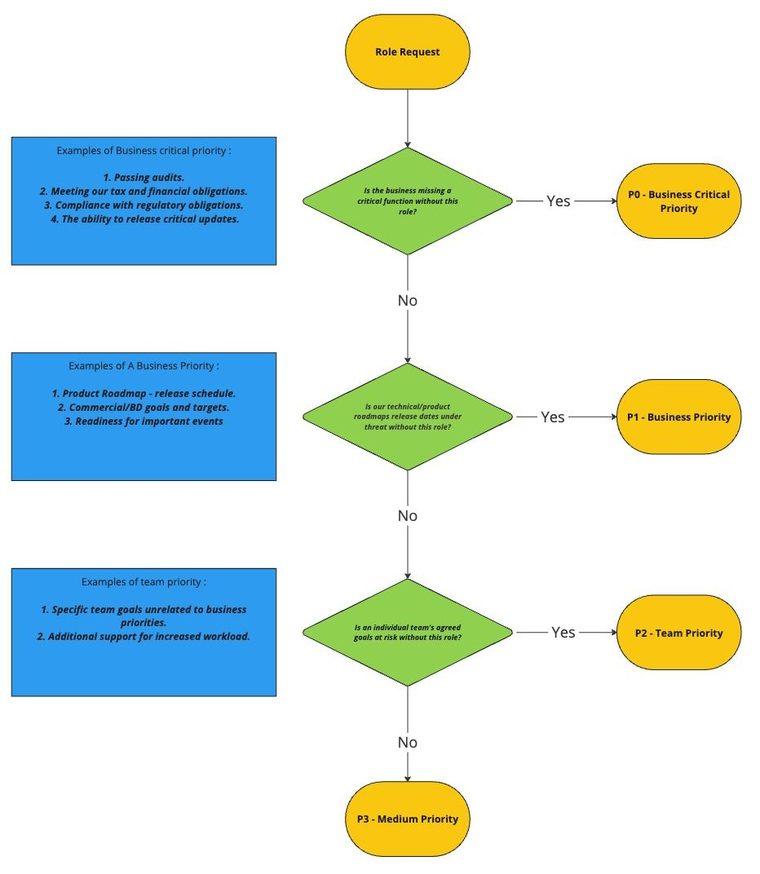
Quick Tip : If you have a simple set of questions that apply to all roles, there's no reason you can't attribute priorities algorithmically from the data in the role request. Write a short decision tree with tiered questions (Example below)
Create a Cross-Functional Hiring Committee
Bring together key leaders from across the business to review and align on hiring priorities. Use data to assess which roles have the biggest business impact and establish a single source of truth for prioritisation.
2. Timelines: No Roadmap, No Resource Allocation
The Problem:
Stakeholders fail to provide clear timelines for when roles are needed. Instead, recruiters are handed a list of roles with immediate demands. Without timelines, talent acquisition can’t allocate resources effectively, leading to delays that threaten product launches, technical roadmaps, and revenue goals. And guess who gets the blame?
The Solution:
Introduce Timeline Mapping
During the workforce planning process, require stakeholders to specify not only what they need but when they need it. Build a hiring roadmap that mirrors the company’s broader strategic roadmap.
Educate Stakeholders on Recruitment Timelines
Use data to show how long it typically takes to fill niche roles. For example, “Machine learning engineers take an average of 45 days to hire. If you need one in Q3, we need to start sourcing by mid-Q2.”
Also encourage your stakeholders to think about human resource when creating their overall product roadmap or marketing strategy. If they haven't considered this, they haven't got a complete roadmap. This helps show the business that the responsibility of assessing needs on time sits with the leader, not the poor recruiter at the bottom of the WFP process.
Set Quarterly Hiring Targets
Break down hiring plans into smaller, time-bound targets that align with business milestones. This creates natural checkpoints and keeps recruitment in lockstep with company needs.
3. Poor Role Requests: Garbage In, Garbage Out
The Problem:
When stakeholders submit vague or poorly scoped role requests, TA is left working with ambiguous information. This results in sourcing the wrong candidates, prolonged calibration periods, and wasted time revisiting the role’s requirements. The knock-on effect? Slower time-to-hire, frustrated candidates, and hiring managers who lose confidence in the process.
The Solution:
Use a Standardised Role Intake Process
Implement a simple, repeatable process for collecting detailed role requirements during kickoff calls. Include specifics like success criteria, must-have skills, and nice-to-haves.
Now i've seen tons of lovely intake templates created for this purpose and then just not get used.
This is because recruiters have the domain knowledge to create the document, but don't think about governance.
make sure that the whole business knows how important this step is. Document the risks of not doing it, the roles and responsibilities of each stakeholder, the timelines and SLAs for completion. what happened if this isn't stuck to.
Train Stakeholders on Writing Effective Role Requests
Provide hiring managers with templates and examples of well-scoped roles. Help them understand that investing time upfront reduces delays and misalignments later.
Pilot Competency-Based Frameworks
Encourage stakeholders to define success in terms of mission, outcomes and competencies rather than buzzwords. For example, instead of “needs blockchain experience,” specify “needs the ability to optimise smart contracts for low-latency environments.”
4. Roles Changing: The Efficiency Killer
The Problem:
When roles are paused, canceled, or changed mid-process, all the work TA has done becomes wasted effort. If 20% of roles in a hiring plan are reprioritised or canceled, it effectively reduces TA’s overall efficiency by 20%. That’s a massive hit to productivity, morale, and opportunity cost.
The Solution:
Build Flexibility Into Hiring Plans
Accept that some role changes are inevitable, but create safeguards to minimise disruption. For example, maintain a rolling list of evergreen candidates who can be redeployed to other roles.
Implement Approval Gateways
Before a role is added to the hiring plan, require stakeholders to demonstrate that it has been properly scoped, prioritised, and budgeted. This reduces the likelihood of midstream changes.
a simple approval workflow that ensures TA has reviewed it's feasibility can be baked into the kickoff process.
Track and Report Role Changes
Use data to show the business the impact of frequent role changes. For example, “Over the past quarter, role changes cost the TA team 300 hours of work, equivalent to $X in opportunity cost, or 3 Full Stack Engineers worth of recruiting,” Transparency can drive better decision-making.
So....
Poor workforce planning impacts recruitment. it creates inefficiencies, misalignments, and wasted resources across the business.
But the good news is, talent acquisition can play a leading role in solving these issues.
Its like a no mans land where leadership, Ta and finance aren't quite taking enough ownership. YOU can take ownership.
By advocating for better prioritisation, clearer timelines, more robust role requests, and fewer midstream changes, TA leaders can reduce chaos, improve hiring outcomes, and save the business significant time and money.
What do you think? What challenges have you faced with workforce planning, and how did you tackle them? Grab me on LinkedIn for a chat! Oh and really, check out TeamOhana!
Luke Update
I'll be down in London in mid-February to do some Ashby training and meet up with some of my awesome Matter Labs people team. Let me know if you fancy a meet up.
Oh... and here's that decision tree I promised.
Well... that's issue thirty four! If you have any questions about it, or any feedback on this issue of The Data Driven Recruiter, grab me on LinkedIn for a chat.
I'll see you next week!