
So, you went to the trouble of parsing through two years of recruitment data from fifteen of the ugliest spreadsheets in the western world, and an ATS thats been used like a garbage can with no index or structure.
Took you about two days. But it's all gonna be worth it, because you can show your findings to the hiring managers and they will all be impressed right?....Right?
"Ooooh look at that lovely data"..."59%....really? We should definitely change our habits then"
Then the day comes and you present your data in a lovely funnel, with some useful insights.....and they don't care.
They wander off bemused and you go home to drink gin and cry under a piano.
Here's what went wrong and a few ways to fix it.
Time & Money
Tattoo that to your forehead, backwards so you can read it in the mirror.
Your mistake was....You gave a non-recruiter recruitment data.
Recruitment is an operational necessity to your hiring manager. They care about the end result. The only other thing they care about is the resources they expend to achieve the end result.
Think of it this way, if you click on a button on a website. Do you care about what webserver is used, in what region? No, the only things that WOULD make you care is if it :
1. It stopped you clicking the button.
2. Took too much time to click the button.
3. Cost you money to click the button.
....THEN you'd care about webservers.
It's the same with your hiring managers.
So if you want to influence change, you need to translate recruitment data into hires, time or money :
❌ "We need to increase conversion at tech stage by 10%" ❌
✅ "If we increase conversion at tech stage 10% we can give you back 75 hours of engineering time" ✅
That's a feature completed on time.
That affects your hiring manager's personal OKRs.
That affects your hiring mangers budget.
THAT will help you influence change.
So thats what you translate your data into. Time and Money.
Here's how to do it
1. Translate your funnel data into a level of effort
a. Start with your target hires (lets say 10)
b. Work out the offers needed based on your offer accept % (lets say 80%)
Offers Needed = 10/0.8
Offers Needed = 12.5
c. do this with every stage right up to screen.
You now have the predicted volume of each stage needed to make the target hires. Your level of effort.
2. Do it again with your future state.
a. pick a conversion you are going to improve, say technical interview by 10%
b. do the same calculation
3. Compare current to future state
a. Note the differences in each stage and think about who it would effect.
This is step by step how you turn basic recruitment data into time and money
Example
- You have figured out that your tech interview has a 55% passthrough rate.
- Firstly, they may not see this as bad. I've met hiring managers who see this as a badge of honour, like "wow this proves we hire only the best".
- You want to increase this by having recruiters shadow tech interviews, do 30 min live prep sessions with candidates and invite engineers to join sourcing sprints.
- You think this can increase the passthrough rate to 65% at least.
- Your hiring manager wont care about an extra 10% passthrough rate at the tech stage because they don't know what that means in terms of the end result, the time and the money.
- So calculate the hours of engineering time saved by increasing passthrough rate across the whole of the engineering hiring plan.
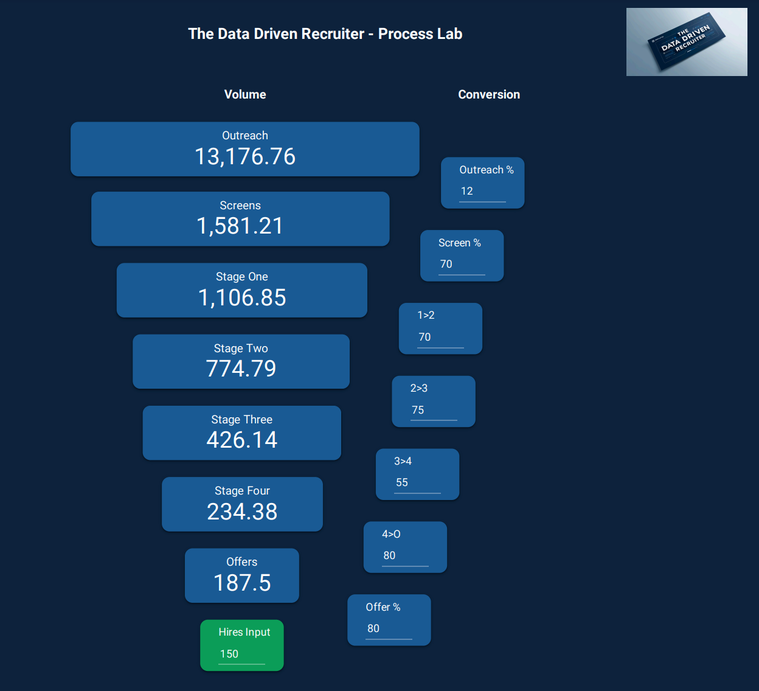
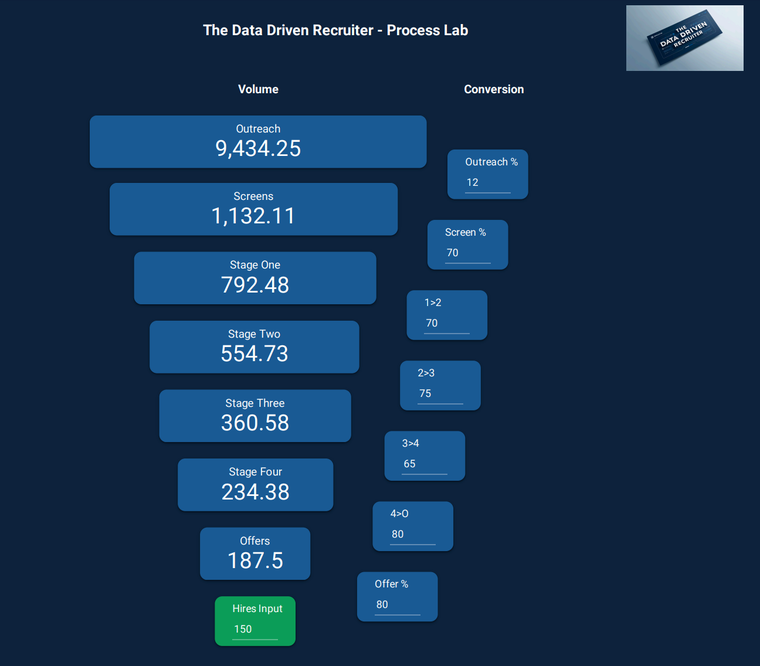
Here we see a 10% increase in conversion at the tech stage for a hiring plan of 150 translates to 66 hours of engineering interviews, 300 less code test reviews and 400 less screens. Saved.
Thats the stuff that moves the needle with your hiring managers.
So have a crack at it yourself and remember, your hiring manager needs recruitment put into context.
Book Update
Progress is coming along at a good clip. I've been hammering through the theoretical sections at light speed as I write extensively on this anyway. I'm also adding any formulas or technical bits in a resources section and writing up common scenarios you can use your new found data.... drivenliness to work through.
Im trying to stay away from decisions related to style as (A) I'm terrible at design and (B) it's just procrastinating from writing the actual content.
That being said, if anyone knows of a good tool to layout a non fiction E-book other than Canva, please let me know!
Well... that's issue 19. If you have any questions about it, or any feedback on this issue of The Data Driven Recruiter, grab me on LinkedIn for a chat.
I'll see you next week!