|
| |
| |
| | |
Issue 55 - Change, and Why Communication Matters |
| | | |
| | |
| Welcome welcome welcome recruiter friends to The Data-Driven Recruiter. My weekly newsletter that aims to help any recruiter who wants to empower themselves with data. Here's what's to expect:
Low level practical advice to empower recruiters.
Every Wednesday
Under a 5 min read
|
| | | |
| | |
Why Communication Matters
Alrighty Recruiters. I've been banging on about change management for weeks now, I've been using strained metaphors about being in a desert, digging into the driest material for The Change Managers Handbook.
You might be thinking "Jeez Louise Luke, I'm here for the data driven recruitment and dark humour. Not a lecture series in effective change management!
And if you are thinking that, I can only apologise. I shall go to the nearest patch of consecrated ground, lie prostrate on the floor and scream "forgive me! I am not worthy of a weekly newsletter!
But hey-ho.
I'm not going to leave this series half done, and communicating change is one of the most important things a recruiter must learn if they are to swing their leg over the fence of reactive recruitment and frolic in the meadow of strategic partnership....
Ok enough of that, let's get down to business, how do you actually communicate change effectively?
|
| | | |
| | | |
| | |
FIRST - A WORD FROM OUR SPONSOR |
| | | |
| | | |
| | | |
| | |
|
|
|
Are you a hard working recruiter? We understand your problems!
You are never off your phone, closing deals, being a big biller and all that bullshit.
But years of agency recruitment has given you the caffeine tolerance of a heavily sedated elephant.
How do you get your 16 daily doses of caffeine without putting the phone down?
Some recruiters have solved this problem, by constantly talking out their ass, but with our new ergonomic caffeine rectal suppositories, that's a thing of the past!
(10% off with this Newsletter)
|
|
|
|
|
|
|
| | | |
| | | |
| | | |
| | |
Back to our regularly scheduled programme. |
| | | |
| | | |
| | | |
| | |
Communication in Change Management
Research consistently shows that the frequency, clarity, and relevance of communication have a greater impact on adoption than the quality of the technology itself. Which is absolutely wild in my opinion.
Communication is how people make sense of what is happening, understand their role, and decide whether to participate.
So poor communication creates confusion, amplifies resistance, and erodes trust.
In most failed implementations, the communication plan is either reactive, or missing altogether.
The TA leader or project sponsor focuses on the technical rollout and assumes users will just..adapt.
In reality, people need multiple touch points, tailored to their context, before behaviour starts to shift.
What the Research Says
-
Prosci found that effective communication is a top-three factor in project success, alongside visible sponsorship and structured change management.
-
McKinsey reported that transformation projects with strong communication strategies are 3.5 times more likely to succeed.
-
Gartner showed that employees need to hear a message five to seven times before they internalise it and act on it.
The Principles of Effective Communication
Successful change relies on communication that informs, aligns, and motivates.
These principles come from established change management frameworks such as Kotter and ADKAR.
-
Clarity - Messages must be simple, direct, and free of jargon.
-
Consistency - The same message should be reinforced across all channels and from all leaders.
-
Relevance - Tailor content to each stakeholder’s perspective.
-
Frequency - Repeat key messages regularly and at multiple intervals.
-
Feedback - Provide ways for people to ask questions and give input.
-
Visibility of Leadership - Senior figures must endorse and model the change.
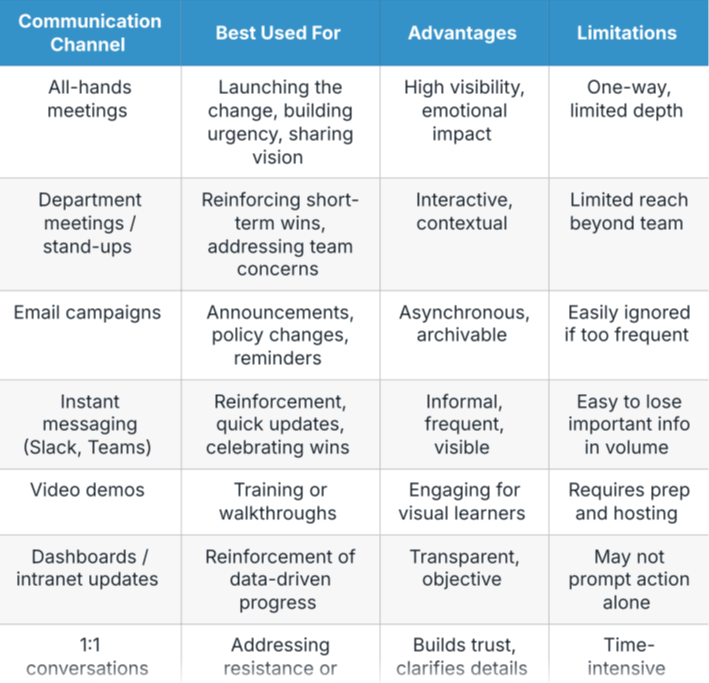
Communication Methods
There isn’t a single best channel. Different audiences respond to different formats.
A strong change plan blends multiple methods to make sure the message is seen, understood, and remembered. |
| | | |
| | | |
| | | |
| | |
| A strong communication plan uses several of these together.
For example, an all-hands announcement supported by ongoing Slack updates, team meetings, and clear documentation in one central place.
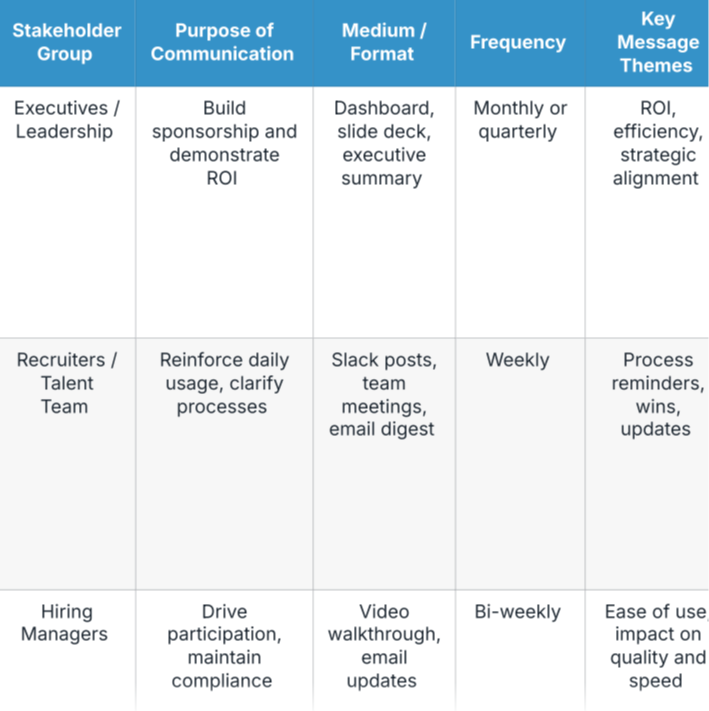
The Communication Content Matrix
To maintain consistency and avoid reactive work, communication during change should be mapped in advance.
A content matrix helps design all key messages before launch, assign ownership, and automate delivery. |
| | | |
| | | |
| | | |
| | |
| A content matrix like this aligns with structured project communication methods used in frameworks like the ones we've previously covered, like Prosci’s ADKAR.
It forces consistency, reduces noise, and ensures that every group knows what to expect and when.
Practical Tips for Implementation
-
Pre-schedule your communications using tools like Slack automation or email schedulers.
-
Create reusable templates for updates, reminders, and recognition posts.
-
Batch messages for the first eight to twelve weeks post-launch to avoid reactive writing.
-
Assign clear ownership. For example, TA Ops sends dashboards, VP People shares leadership updates.
So...
Even the best change frameworks fail without consistent, structured communication.
You can have urgency, a vision, a plan, buckets of gumption and all the right tools, but if people don’t understand what’s happening, what it means for them, or why it matters, it will collapse.
Communication is the currency of change.
Plan it as carefully as the implementation itself, and you’ll see adoption rise before the tool even goes live. |
| | | |
| | | |
|